

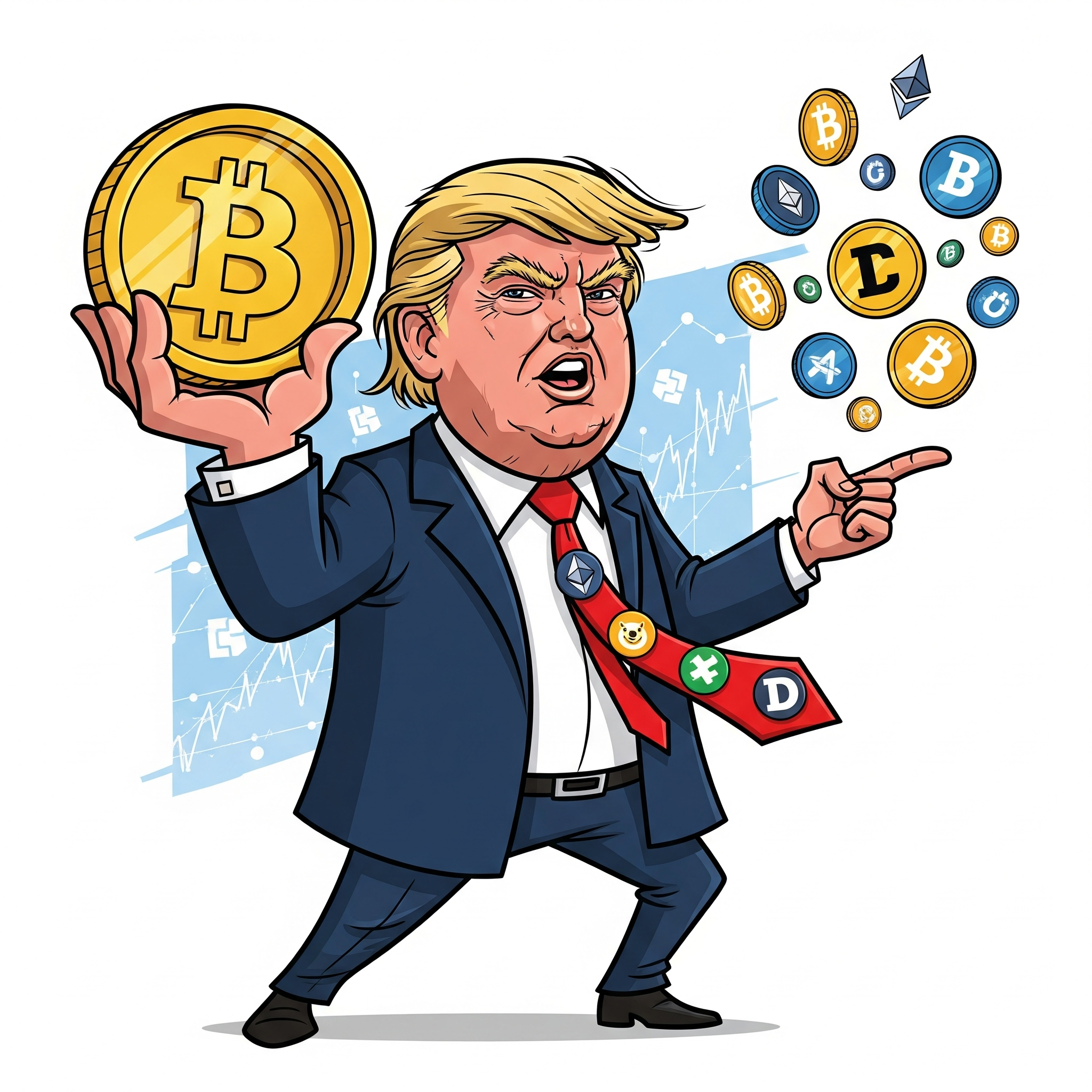
The present U.S. administration, beneath President Donald J. Trump, has executed a speedy and complete pivot in its strategy to digital property, shifting from a place of historic skepticism to certainly one of strategic embrace. This new doctrine isn’t a set of remoted insurance policies however a coherent, multi-pronged technique designed to place america as the worldwide chief in digital finance. The core of this technique is constructed upon a sequence of foundational govt orders, landmark legislative acts, and a basic philosophical shift inside key regulatory our bodies.
The administration’s imaginative and prescient is articulated by means of a number of key pillars: the institution of a transparent and safe regulatory framework for stablecoins through the GENIUS Act, a definitive prohibition of Central Financial institution Digital Currencies (CBDCs) by means of the Anti-CBDC Surveillance State Act, and a serious reorganization of the Securities and Alternate Fee (SEC) to facilitate, slightly than impede, innovation. Moreover, the strategic institution of a nationwide Bitcoin reserve represents a monumental act of legitimization for digital property. The acknowledged targets of this doctrine are to foster innovation, strengthen the U.S. greenback’s international reserve standing, shield client privateness and monetary freedom, and appeal to large funding and expertise to the American digital asset sector.
The impression of those coverage modifications has been instant and profound. Bitcoin’s worth has surged previous $100,000 and is approaching $150,000, pushing the overall cryptocurrency market valuation past $4 trillion for the primary time.This home coverage shift can also be setting a world precedent, with nations like Pakistan and Bhutan exploring their very own Bitcoin reserves, and rising economies akin to India seeking to the U.S. framework as a possible blueprint for their very own regulatory efforts.This report gives an in-depth evaluation of this new doctrine, analyzing its elements, underlying strategic rationale, and far-reaching international implications.
Half I: Forging a New Digital Asset Doctrine
A Shift in Stance: From Skepticism to Strategic Embrace
The present administration’s digital asset coverage represents a big ideological and political pivot. President Trump, who had beforehand expressed skepticism towards cryptocurrencies, has turn out to be a vocal proponent, stating that the U.S. should “keep within the entrance of this one”.This transformation isn’t a coincidence; it’s a strategic alignment with a burgeoning trade that supplied important political and monetary help for his 2024 marketing campaign, with executives “strongly help[ing] Trump’s 2024 marketing campaign” and contributing “thousands and thousands” to his efforts.The brand new coverage successfully rewards this political help by delivering on a marketing campaign promise to place America because the “international chief in cryptocurrency” and make the U.S. the “crypto capital of the world”.
A central factor of this strategic shift is the deliberate and specific reversal of the earlier administration’s strategy. The brand new govt order, “Strengthening American Management in Digital Monetary Know-how,” explicitly revokes former President Joe Biden’s EO 14067 and the Treasury Division’s Framework for Worldwide Engagement on Digital Belongings.This act of reversal frames the brand new coverage as a direct corrective motion towards what’s portrayed as an period of unfair assaults on digital property.The administration’s help for the Anti-CBDC Surveillance State Act is equally positioned as a direct response to the “Biden Administration[‘s]” alleged willingness to create a “CBDC surveillance-style system,” turning digital asset coverage right into a key battleground in a broader political and ideological battle.This framing means that the coverage is as a lot about political differentiation and an attraction to a particular voter base as it’s about fostering financial innovation.
The Foundational Government Orders of 2025: A Timeline of Motion
The administration’s digital asset agenda was initiated and solidified by means of a sequence of foundational govt orders (EOs) within the first half of 2025, demonstrating a excessive diploma of operational intent and a want to behave swiftly.
On January 23, 2025, the President signed the EO titled “Strengthening American Management in Digital Monetary Know-how”.This order serves because the grasp blueprint for the whole technique. It mandates the safety and promotion of open public blockchain networks, the promotion of lawful dollar-backed stablecoins to bolster the U.S. greenback’s sovereignty, and a prohibition on the institution and use of a Central Financial institution Digital Foreign money (CBDC) inside america.Critically, the EO established a brand new “President’s Working Group on Digital Asset Markets,” to be chaired by a newly created place, the “Particular Advisor for AI and Crypto,” a task held by David Sacks.The working group was tasked with proposing a complete federal regulatory framework for digital property inside 180 days, specializing in market construction, client safety, and danger administration.
This preliminary EO was adopted by one other landmark motion in March 2025, which established a “Strategic Bitcoin Reserve” and a “U.S. Digital Asset Stockpile”.This order prohibits the U.S. authorities from promoting any Bitcoin it has acquired by means of regulation enforcement and permits the Treasury and Commerce Departments to develop plans to amass further Bitcoin, signaling a profound shift within the authorities’s posture in direction of the asset.This motion is not only a passive holding of property; it’s a monumental act of legitimization that positions Bitcoin as a strategic nationwide asset and a pacesetter amongst nations in authorities digital asset technique.
A separate govt order additionally mandated an investigation into whether or not banks have discriminated towards sure industries, together with cryptocurrency corporations.This addresses a key grievance from the trade, which has lengthy felt marginalized by the standard banking system. By ordering a probe into this alleged “debanking,” the administration alerts its dedication to making sure the crypto trade has truthful and equal entry to banking providers, thereby integrating it extra absolutely into the mainstream monetary ecosystem. These EOs, deployed in a coordinated sequence, show a calculated use of govt authority to quickly set the coverage route, set up new institutional our bodies, and tackle key trade ache factors earlier than the slower legislative course of may take maintain.
Half II: The Legislative Pillars of Digital Finance
The GENIUS Act: A Regulatory Blueprint for Stablecoins
The GENIUS Act, formally titled the Digital Asset Market Readability Act of 2025, is the legislative centerpiece of the administration’s technique, designed to supply a transparent and safe framework for stablecoins. The Act formally acknowledges stablecoins as monetary merchandise and establishes a complete authorized and coverage framework for his or her operation.Its core provisions are designed to foster belief and stability within the burgeoning market, which presently holds a valuation of roughly $250 billion.
Key necessities of the GENIUS Act embody:
- A mandate for all stablecoins to be backed 1:1 with liquid reserves, akin to money or short-term U.S. Treasuries.
- A requirement for issuers to supply month-to-month, public disclosures of the composition of their reserves.
- The implementation of strict advertising and marketing guidelines to guard customers from misleading practices, together with prohibitions towards deceptive claims that stablecoins are government-backed, federally insured, or authorized tender.
- Within the occasion of an issuer’s insolvency, the Act prioritizes stablecoin holders’ claims over all different collectors, offering an important backstop for client safety.
The Act’s strategic intent extends far past home regulation. The administration explicitly goals to make use of stablecoins as a instrument to make sure the continued international dominance of the U.S. greenback because the world’s reserve foreign money.By driving demand for U.S. Treasuries, stablecoins will play a essential position in anchoring a brand new, digital monetary system to the U.S. greenback. The framework is designed to de-risk the stablecoin marketplace for conventional monetary establishments and tech giants, akin to JPMorgan Chase, Amazon, Mastercard, and Financial institution of America, that are reportedly exploring the launch of their very own stablecoins.This regulated setting gives the institutional readability and security crucial for these massive, risk-averse gamers to enter the market, successfully bridging the hole between conventional finance and the digital asset area and making certain that future monetary innovation happens on American soil and beneath American guidelines.
The Anti-CBDC Surveillance State Act (H.R. 1919)
The Anti-CBDC Surveillance State Act (H.R. 1919) serves because the ideological counterweight to the GENIUS Act. This invoice, which the administration strongly helps, prohibits the Federal Reserve from growing or issuing a Central Financial institution Digital Foreign money with out specific congressional authorization.The laws is framed as a daring protection of American rules, particularly “monetary privateness and constitutional liberties”.
The administration’s coverage supplies explicitly distinguish a CBDC from decentralized digital property. A CBDC is described as “government-controlled, programmable cash” with transactions occurring on a government-managed ledger, which could possibly be used for surveillance or to “suppress politically unpopular actions”.This stands in stark distinction to the administration’s promotion of open, decentralized digital property. By codifying a everlasting ban on a government-controlled digital foreign money, the administration goals to forestall what it perceives as a menace to particular person freedoms and solidify its picture as a champion of privateness and monetary liberty. This authorized motion serves a twin objective: it gives a definitive reassurance to the crypto trade and aligns the administration’s digital asset coverage with a conservative political base that’s skeptical of presidency overreach and potential surveillance.
Half III: Reshaping the Regulatory Atmosphere
The SEC’s New Path Ahead: The Crypto Activity Drive
A essential element of the administration’s strategic shift is the basic overhaul of the regulatory strategy on the Securities and Alternate Fee (SEC). Beneath Appearing Chairman Mark T. Uyeda, the SEC introduced the formation of a brand new “Crypto Activity Drive” on January 21, 2025, which marks a big departure from the earlier technique of “regulation by enforcement”.This earlier strategy had created a hostile and complicated setting for digital asset innovation. The brand new job pressure, led by Commissioner Hester Peirce, signifies a transfer towards a extra collaborative and clear regulatory framework.
The duty pressure’s mandate is complete and displays the administration’s new philosophy. Its particular targets embody:
- Clarifying the regulatory standing of various classes of crypto property as securities.
- Figuring out crypto property or associated areas that fall outdoors the SEC’s jurisdiction.
- Exploring a possible “secure harbor” for sure coin and token choices.
- Offering a sensible path for crypto asset securities to register.
- Transforming present guidelines on custody and clearing businesses to raised accommodate digital property.
- Making a “cross-border sandbox” to facilitate worldwide crypto initiatives.
Commissioner Peirce’s management is a deliberate sign of this new route. She has lengthy criticized the SEC’s reliance on enforcement actions with out offering ample steering, and her management confirms the company’s dedication to a brand new, extra clear strategy that seeks enter from buyers, trade members, and teachers.The duty pressure is actively welcoming requests for “no-action letters,” a observe that had fallen out of use with respect to crypto and is now being revived to supply regulatory readability.This alignment between the manager department’s coverage targets and the actions of a key regulatory company demonstrates a tightly coordinated effort to deliver coherence and predictability to a beforehand chaotic regulatory panorama.
Half IV: International Influence and Worldwide Ripple Results
The “Trump Rally”: Market Responses and International Valuation
The great U.S. coverage bulletins have had an enormous and instant impression on the worldwide cryptocurrency market. The promise of a transparent and supportive regulatory framework has injected new confidence, resulting in a big rally in digital asset costs. Bitcoin, the world’s most distinguished cryptocurrency, has surged previous $100,000 and is now approaching $150,000.This ascent contributed to the overall crypto market valuation surpassing $4 trillion for the primary time.This market response is a strong testomony to the worldwide affect of U.S. coverage and the essential significance of regulatory certainty in driving market progress and institutional adoption. One report famous that the value of bitcoin was up 2% on a Thursday to $116,542 following the signing of an govt order to permit higher-risk investments like cryptocurrency in 401(okay) accounts.
Adoption Overseas: A New American Blueprint
The ripple results of the U.S. coverage shift are being felt globally. A rising variety of nations are reportedly following the U.S.’s lead, with some taking decisive steps to combine digital property into their nationwide financial methods. For instance, Pakistan’s Crypto Council CEO has revealed the nation’s plan to determine a Bitcoin reserve, whereas Bhutan has disclosed a considerable BTC reserve valued at $1.3 billion, which represents practically 40% of its GDP.These actions are usually not remoted occasions; they’re proof of the U.S.’s profitable delicate energy within the digital finance area, as different nations look to the American framework as a viable and profitable mannequin.
The U.S. coverage additionally has important implications for main international gamers like India. India is the world’s largest recipient of remittances, receiving $130 billion in 2024, and stands to learn significantly from the effectivity and low prices of stablecoin-enabled transfers.Though India stays in a “regulatory gray space” with a heavy taxation regime and a pending crypto invoice since 2021, the GENIUS Act affords a possible blueprint for a brand new regulatory path ahead.The Act’s rules of straightforward licensing procedures, full reserve mandates, and transparency by means of audits may function a mannequin for India to undertake laws that fosters belief and innovation, thereby enabling the safe and compliant use of stablecoins and different Digital Digital Belongings (VDAs).This demonstrates how the U.S. is not only innovating domestically however is actively exporting a regulatory mannequin that would form the worldwide digital monetary system.
Conclusion: A Ahead-Trying Perspective
The administration’s digital asset doctrine is a coherent and multi-faceted technique that leverages govt authority, legislative motion, and regulatory reform to realize a singular imaginative and prescient: the institution of america as the worldwide chief in digital finance. This proactive embrace of the digital asset trade is pushed by a want for financial management, a particular political ideology that champions monetary liberty and particular person privateness, and a response to the geopolitical crucial of sustaining American dominance in a brand new technological period.
The insurance policies outlined on this report—from the definitive stablecoin framework of the GENIUS Act to the prohibition of government-controlled CBDCs—are usually not only a assortment of latest guidelines. They’re foundational components of a brand new institutional infrastructure designed to draw innovation and funding whereas defending the sovereignty of the U.S. greenback. The shift on the SEC from a punitive strategy to a collaborative one, spearheaded by a pro-innovation job pressure, gives the mandatory regulatory readability to unlock the complete potential of the sector.
Whereas the technique is designed to advertise free-market innovation, it is very important notice that additionally it is a type of centralized steering. By defining the principles for stablecoins and explicitly legitimizing sure property like Bitcoin, the administration is actively shaping the market’s evolution, slightly than permitting it to develop totally unconstrained. This calculated strategy is meant to de-risk the sector for conventional monetary gamers, thereby making certain that the digital future is constructed inside a framework of American regulation and values. The worldwide ripple results already noticed in nations like Pakistan, Bhutan, and India counsel that the U.S. is not only collaborating within the international digital asset panorama however is actively setting its requirements and constructing the infrastructure for a future monetary system in its personal picture.

