


The panorama of person acquisition and group constructing within the cryptocurrency area has undergone a profound transformation. Within the early days, initiatives often relied on a advertising and marketing technique referred to as an airdrop, which concerned distributing free tokens to a group to bootstrap adoption, decentralize governance, and reward early contributors.Whereas this method proved efficient in producing preliminary buzz, it rapidly revealed a sequence of systemic flaws. The first concern was the rise of “airdrop hunters” or “farmers”—speculators who would carry out minimal actions to qualify for an airdrop after which instantly promote the tokens upon receipt, creating immense “promote strain” on the brand new asset.This apply led to fast and vital drops in token worth and distorted the challenge’s metrics, finally undermining its long-term viability and the loyalty of real customers.
In response to those challenges, a brand new and extra refined incentive mannequin has emerged: the factors system. This method, tailored from time-tested advertising and marketing methods present in Web2 loyalty applications, is designed to encourage sustained engagement over an extended interval.As a substitute of issuing a tradable token with speedy worth, initiatives grant customers digital factors as a type of “IOU” for future rewards. This strategic delay permits a challenge to bootstrap its community and collect useful knowledge on person conduct whereas avoiding the untimely market volatility that a direct token launch would trigger.The factors are supposed to act as an important bridge, a non-liquid asset that incentivizes early customers and provides the challenge time to determine “enough community worth” earlier than a full Token Era Occasion (TGE).
The consequence of this evolution is a brand new and dynamic sub-economy referred to as “PointFi” or the “Level Financial system”.On this ecosystem, factors themselves have develop into the product, resulting in a brand new layer of hypothesis the place market individuals commerce on the anticipated worth of a future token conversion. This phenomenon has created a fancy net of incentives and behaviors, forcing each initiatives and customers to navigate a panorama the place the promise of a reward is commonly as useful because the reward itself.The emergence of PointFi represents a basic shift from the blunt, one-time rewards of early airdrops to a extra steady and data-driven method to group engagement.
II. The Mechanics of the Factors System: A Story of Two Fashions
At its core, a crypto factors system is a structured mechanism for assigning worth to particular actions or behaviors inside a group or platform.These digital property are issued by a challenge to reward customers for actions resembling offering liquidity, staking tokens, or participating with a decentralized utility (dApp).A vital distinction is that crypto factors usually are not cryptocurrencies; they lack a financial worth, can’t be traded on open markets, and are usually recorded off-chain.Their perceived worth is derived solely from the challenge’s promise of a future redemption, resembling a conversion to a local token, reductions, or unique advantages.
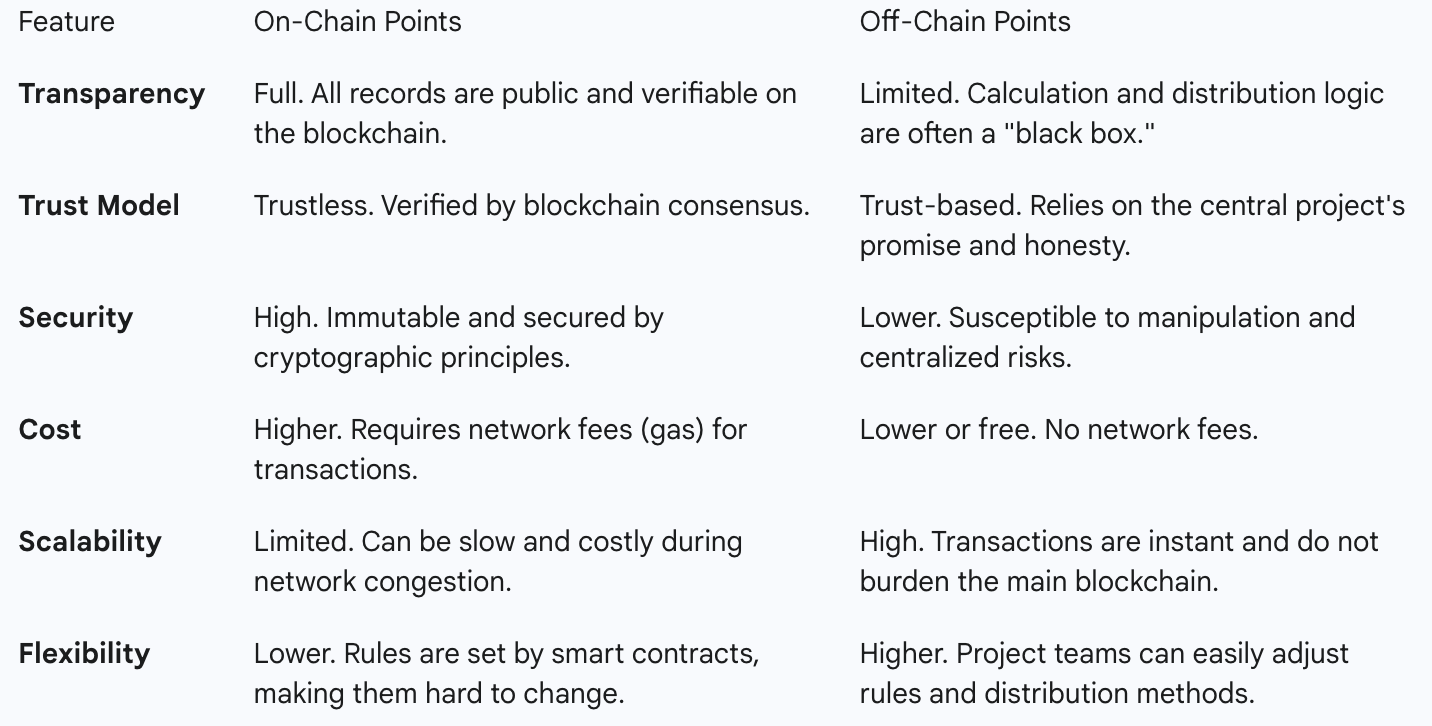
The overwhelming majority of present factors applications function in an off-chain mannequin. On this setup, a selected Web3 challenge or platform is chargeable for disseminating and monitoring the factors in a centralized method.The first benefit of this method is its operational effectivity: transactions are quicker, cheaper, and extra scalable as a result of they don’t require community consensus or fuel charges.This mannequin additionally provides challenge founders immense flexibility to regulate the principles, concern enhance multipliers, and retroactively decide the ultimate token allocation based mostly on person conduct knowledge.
Nonetheless, this prevalent off-chain mannequin presents a basic paradox throughout the Web3 ethos. Whereas the core promise of cryptocurrency is to take away the necessity for centralized belief and intermediaries by way of clear, decentralized expertise, the factors programs used to construct many of those communities are opaque and centralized.The full provide of factors, the distribution logic, and the ultimate conversion fee is usually a “black field,” requiring customers to position a degree of belief within the challenge’s founders that the underlying blockchain expertise was designed to eradicate.
A newer improvement is the emergence of on-chain factors programs, that are designed to deal with the centralization paradox. On this mannequin, factors are recorded instantly on a blockchain, which supplies a bunch of advantages that align extra intently with the ideas of decentralization.This method ensures transparency, credibility, and immutability, as all distribution and utilization information are publicly auditable and can’t be manipulated.On-chain factors additionally supply the benefit of cross-platform interoperability, permitting them to be transferred or used throughout totally different dApps, which isn’t attainable in a closed, off-chain system.The selection between these two fashions is due to this fact not only a technical one, however a strategic determination that displays a challenge’s dedication to the core values of Web3. The continued use of opaque off-chain programs might be seen as a tactical regression to a Web2 mannequin, the place the success of a “decentralized” challenge nonetheless depends closely on belief in a government.
For instance the important thing variations, the next desk supplies a comparability of the operational and philosophical attributes of on-chain and off-chain factors programs.
III. The Strategic Crucial: Why Tasks Undertake a Factors System
The strategic adoption of a factors system is a multifaceted determination for a Web3 challenge, pushed by a need to beat the restrictions of conventional airdrops and construct a extra resilient ecosystem.
Gamification and Deeper Engagement
Tasks use factors to gamify their protocols and make person interactions extra participating.By introducing components like quests, achievements, badges, and leaderboards, initiatives can create a way of competitors and group, reworking easy transactions right into a rewarding expertise.For instance, a challenge may reward customers with factors for finishing a profile, following social media, or taking part in a hackathon.This game-like construction motivates customers to work together extra often and deeply with the platform, fostering a stronger connection between the challenge and its group.
A Bridge to Tokens: The “IOU” Technique
One of the crucial essential features of a factors system is to behave as a bridge to a future token.As a substitute of launching a token instantly, which dangers a large sell-off, initiatives can use factors to incentivize early adopters with an “IOU” for future tokens.This technique permits initiatives to draw customers and liquidity on the fragile, early phases of improvement. It provides the group useful time to construct the community’s utility and create “enough community worth” earlier than the token is launched. By delaying the TGE, initiatives can theoretically guarantee a extra secure token and a extra loyal person base, because the rewards are tied to a sustained contribution over time moderately than a single motion.
Sybil Resistance and Fairer Distribution
The factors system can be a complicated device for combating Sybil assaults and airdrop farming.Sybil assaults contain malicious actors creating a number of faux identities or wallets to realize a disproportionate quantity of airdrop rewards.By designing a factors system that rewards sustained, multi-faceted engagement over a protracted interval, initiatives can considerably improve the “value of forgery” for a Sybil attacker.A farmer should now make investments extra time, capital, and technical assets to take care of a number of wallets over an prolonged interval to build up sufficient factors to be significant. This raises the barrier to entry and, in idea, ensures a fairer distribution to real, long-term customers. Nonetheless, this isn’t an impenetrable protection. A complicated arms race has emerged, with skilled farmers utilizing superior instruments like antidetect browsers, bots, and a number of wallets to automate their actions and bypass these new defenses.This merely shifts the issue from low-effort farming to a extra superior, capital-intensive type of exploitation, which may nonetheless dilute the rewards of real customers.
Neighborhood and Governance Constructing
Factors programs can play an important position in constructing a vibrant and engaged group. By providing factors for actions resembling taking part in group discussions or governance initiatives, initiatives can encourage customers to contribute to the challenge’s development and sustainability.In some instances, factors might be tied on to future governance rights, giving customers a tangible stake within the challenge’s future path and improvement.This method helps rework a passive person base into an lively, invested group.
IV. The Consumer’s Perspective: Advantages and Behavioral Shifts
For a lot of customers, taking part in a crypto factors system presents a low-barrier-to-entry alternative to build up digital property with out vital monetary threat.This “earn when you be taught” mannequin is especially interesting to newcomers who want to interact with new initiatives and applied sciences with out a big upfront funding.The quantifiable and clear nature of factors, typically displayed on a public leaderboard, additionally creates a way of meritocracy and accomplishment.Customers can clearly see how their actions contribute to their rating, offering a visual and speedy suggestions loop that’s extremely motivating.
Moreover, referral applications, a standard function of factors programs, present a direct incentive for customers to develop into a challenge’s largest advocates.A person can earn a proportion of factors from associates they invite, making a viral development loop that accelerates adoption.Nonetheless, this constructive suggestions loop may also result in an unhealthy fixation on the factors themselves. The speculative promise of a future token could cause customers to develop into overly centered on accumulating factors moderately than participating with a challenge’s core utility or expertise.On this situation, the factors develop into the product, and a challenge’s success is measured by its capacity to generate hype moderately than its capacity to ship on a significant use case.
V. Case Research: Factors Programs in Follow
An examination of real-world examples demonstrates the divergent outcomes of factors programs and the strategic selections that result in success or failure.
Blur: The NFT Market Kingmaker
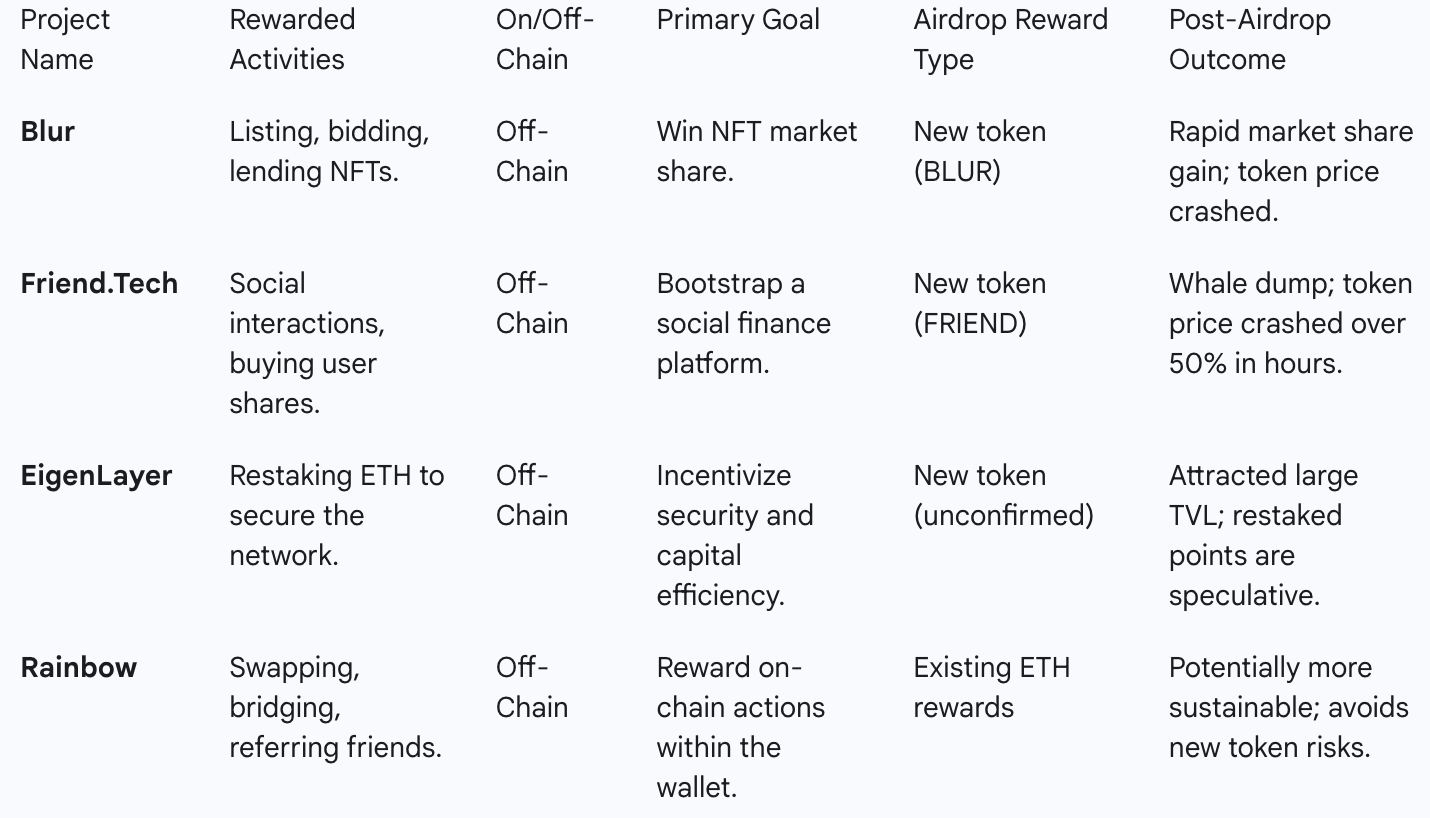
The NFT market Blur used a complicated factors system to aggressively problem market chief OpenSea.Blur’s airdrop technique awarded “Loyalty” scores and distributed “Care Packages” of various rarity to customers who listed, bid on, and lent NFTs on its platform.This mannequin was particularly designed to incentivize high-risk conduct and drive deep liquidity, a technique that paid off handsomely within the quick time period. By providing zero buying and selling charges and beneficiant points-based rewards, Blur efficiently overtook OpenSea in buying and selling quantity and captured a good portion of the market.Nonetheless, the long-term sustainability of this mannequin stays unsure. Following its airdrop, the BLUR token skilled excessive value volatility, with its worth plummeting by over 90% from its all-time excessive, a basic instance of post-airdrop promote strain.Blur’s case demonstrates {that a} factors system is usually a highly effective device for successful a market share battle, however it doesn’t present an inoculation towards the speculative conduct and value instability that usually comply with a token launch.
Buddy.Tech: A Cautionary Story of Social Finance
The decentralized social networking app Buddy.Tech employed an off-chain factors system that rewarded customers for interactions on its platform with weekly factors drops and the promise of a future token.This generated immense hypothesis and attracted a big person base, however the centralized and opaque nature of its factors distribution left it weak to exploitation. The token launch supplies a stark instance of this threat: a whale farmer, the most important airdrop recipient, instantly offered over 55,000 of the newly issued tokens, inflicting the value to crash by over 50% in a matter of hours.This incident served as a robust cautionary story, highlighting how an absence of transparency and a deal with speculative rewards might be exploited by skilled farmers, resulting in a catastrophic token launch and a lack of group belief.
EigenLayer & Rainbow: A Divergent Path
Some initiatives have adopted factors programs for extra focused and probably sustainable functions. EigenLayer, a restaking protocol, makes use of “Restaked Factors” to reward Ethereum validators for his or her contributions to community safety, a extra institutional-focused method.Rainbow, a crypto pockets, presents a rewards program that grants “Rainbow Factors” for on-chain actions like swapping and bridging, however with a key distinction: the rewards are distributed as weekly ETH airdrops, not a brand new, speculative token.The divergence of those fashions from these of Blur and Buddy.Tech is an important level of research. By rewarding customers with a liquid, present asset like ETH, Rainbow could also be making a extra sustainable mannequin that avoids the “points-to-token-dump” cycle fully, suggesting a path ahead for initiatives that search to construct real, long-term communities with out succumbing to the inherent dangers of launching a brand new speculative asset.
VI. The Inherent Dangers and Criticisms
Whereas the factors system has develop into a dominant incentive mannequin, it isn’t with out vital dangers and criticisms.
The Hypothesis Over Utility Downside: One of the crucial widespread critiques is that the system can create a situation the place the buildup of factors turns into the first goal, overshadowing the precise utility or worth of the challenge itself.This could result in initiatives prioritizing hype and speculative curiosity over growing a strong, long-term use case, finally making a unstable and unsustainable ecosystem.
Regulatory Scrutiny and “Decentralization Theater”: The authorized and regulatory standing of factors programs is a rising concern. Regulatory our bodies just like the SEC could view a challenge’s use of a factors system as a technique to conduct an unregistered securities providing, particularly when the factors are a transparent precursor to a future token.The SEC has expressed skepticism in the direction of “decentralization theater,” the place initiatives declare to be decentralized whereas sustaining centralized management over key mechanisms, resembling an opaque factors system.This poses a big authorized threat for initiatives that don’t prioritize transparency and true decentralization.
Centralization and Lack of Transparency: The reliance on off-chain factors programs, that are managed and managed by a central group, stands in direct distinction to the decentralized ideas of Web3.This centralization creates an absence of transparency concerning the whole provide of factors, the distribution schedule, and the eventual conversion charges, all of which might be manipulated by the challenge’s founders. This opaqueness forces customers to position belief in a single entity, which is the very drawback that blockchain expertise was created to unravel.
Environmental Influence: Whereas factors programs themselves usually are not energy-intensive, they’re typically used to incentivize actions on blockchains that make the most of Proof-of-Work (PoW) consensus mechanisms, which have a big environmental footprint.By driving person engagement on these networks, factors programs can not directly contribute to their power consumption and carbon emissions.
VII. Conclusion: A Path to a Sustainable Factors Financial system
The crypto factors system represents a crucial evolution from the blunt, easily-gamed airdrops of the previous. It’s a highly effective and complex device for managing community development, incentivizing group engagement, and strategically controlling market dynamics. Nonetheless, its effectiveness and long-term viability rely fully on a challenge’s design selections and its dedication to the core ideas of Web3.
The way forward for a sustainable factors financial system will doubtless contain a transparent and decisive shift in the direction of extra clear, on-chain fashions.By leveraging the immutability and auditability of the blockchain, initiatives can construct factors programs that aren’t simply extra environment friendly but additionally extra credible and honest, thereby restoring the belief that the opaque, off-chain mannequin has eroded.
Moreover, initiatives should evolve their perspective on factors, viewing them not as a remaining reward however as a mechanism to domesticate a real, long-term group. Probably the most profitable and resilient initiatives might be people who tie factors to tangible utility, resembling governance rights, and discover methods to retain customers past the preliminary speculative hype.The market has already supplied highly effective examples of each airdrop successes and catastrophic failures, and because the ecosystem matures, customers will develop into more and more discerning. The longer term will belong to initiatives that prioritize verifiable, long-term worth over short-term speculative positive aspects.

