


Lower than 60 days after launch, DWF Labs’ stablecoin stumbled beneath $1 as customers pulled liquidity and doubts mounted over its reserves.
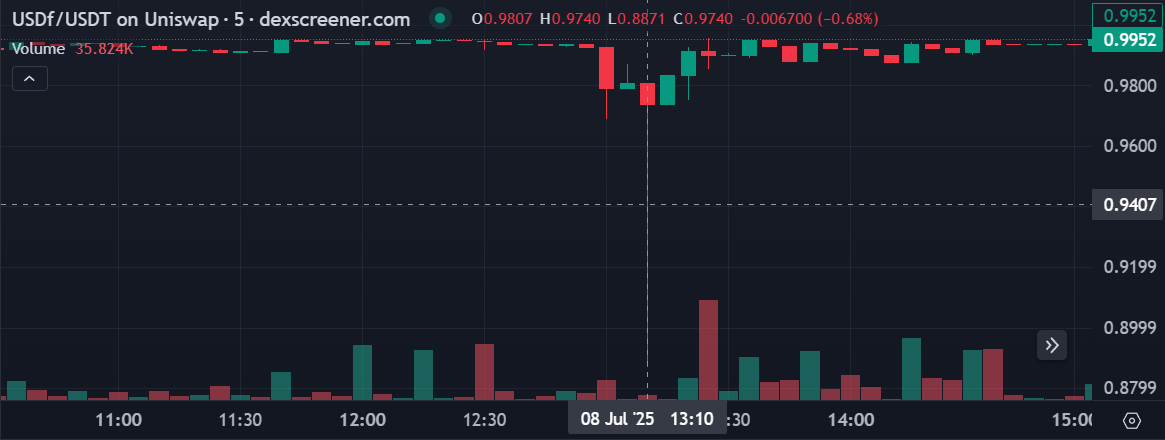
DWF Labs’ artificial stablecoin Falcon USD (USDf) misplaced its peg to the U.S. greenback earlier this week, dropping in a second to as little as $0.8871 early on July 8, per knowledge from DEX Screener, amid mounting issues about how properly its collateral and danger fashions maintain up below stress.
At press time in the present day, July 10, the stablecoin has but to totally get better its peg, buying and selling slightly below $1 at $0.998.
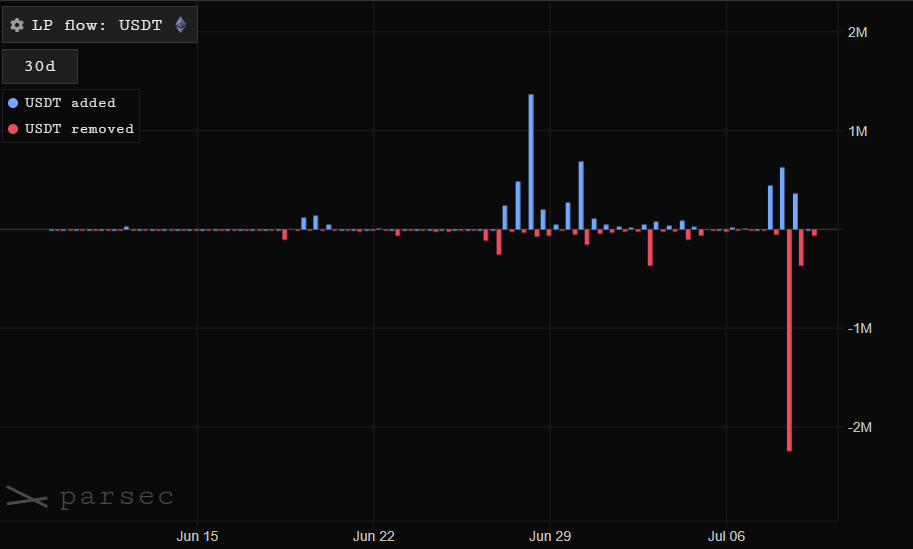
Knowledge from blockchain analytics platform Parsec present that liquidity suppliers pulled greater than $2 million from the Uniswap USDT/USDf pool in a brief span on July 8, after the depeg.
DWF Labs is a market maker and funding agency, in addition to the main backer of Falcon Finance, which launched its stablecoin in April.
The worth drop got here amidissues concerning the stablecoin’s backing and the shortage of readability round how its yields are calculated. Falcon has continues to promote returns as excessive as 15% APY, whereas charges on extra established lending platforms like Aave are presently a lot decrease, nearer to 3-4%.
In contrast to many USD stablecoins which might be backed one-to-one by money or U.S. Treasury payments, USDf is an overcollateralized artificial stablecoin with a mixture of eligible crypto that customers can deposit as collateral to mint USDf. Supported property for deposit embrace USDC, USDT, BTC and ETH — together with some lower-liquidity altcoins, a construction that has already drawn scrutiny from some market watchers.
Nearly half-hour previous to the depeg occasion, DWF Labs CEO Andrei Grachev printed an X article outlining Falcon’s reserves and technique. He wrote that USDf is 116% overcollateralized, with about 89% of reserves held in BTC and stablecoins and the remaining in altcoins. He added that the protocol earns income by means of foundation buying and selling, arbitrage, staking, and OTC offers.
Depeg Impression
In the identical X thread, Grachev acknowledged issues about transparency and stated an up to date dashboard with a clearer breakdown of reserves — together with altcoin holdings — could be printed subsequent week.
Whereas the put up offers a normal sense of how Falcon generates yield, it nonetheless leaves a variety of open questions. There’s no detailed breakdown displaying how a lot every technique contributes, how sustainable they are surely, or what sort of danger is concerned. It’s additionally unclear if any of the returns are being boosted by leverage, exterior capital, or incentive applications.
DeFi danger analysis agency LlamaRisk flagged potential issues in a Could discussion board put up, citing restricted disclosure, centralized management over property, and the power to mint USDf utilizing low-cap tokens like DOLO. At one level, Falcon even allowed as much as $50 million in USDf to be minted in opposition to DOLO, which had a market cap of simply $14.2 million, in response to the put up and CoinGecko knowledge.
The Defiant reached out to the DWF Labs workforce for touch upon the depeg incident and group issues, however hasn’t heard again by press time.
Gitay Shafran, founding father of The Fedz, a stablecoin startup, instructed The Defiant that when a token loses its peg, the results might be instant and extreme. “A stablecoin’s total worth hinges on that $1 peg; as soon as it cracks, liquidations cascade, customers panic, and the core utility collapses,” he stated.
Shafran added that whereas excessive yields aren’t inherently scams, they do require “radical transparency: the place the yield comes from, the way it’s collateralized, and the way it holds up their liquidity below stress.”
In his view, excessive yields might be justified if dangers are clearly disclosed and customers perceive how the returns are generated. “The issue arises when opacity replaces transparency, leaving customers at nighttime about actual backing and publicity,” he stated.
Tzahi Kanza, CEO of crypto enterprise studio Syndika, stated depegging usually happens when customers suspect the collateral backing a stablecoin is inadequate, or once they merely can’t see sufficient knowledge to show in any other case.
“The larger difficulty arises when there is a lack of clear knowledge, resulting in panic pushed by hypothesis or rumors,” Kanza instructed The Defiant. He famous that small deviations from the peg aren’t unusual, declaring that even USDC briefly fell 10% beneath its peg throughout the collapse of Silicon Valley Financial institution in 2023.
Per Kanza, the answer lies in clearer guidelines and common reporting. “Such rules are already being carried out within the EU and the US, and this case clearly highlights why they’re crucial,” he stated.
In April, DeFi protocol Synthetix’s sUSD stablecoin skilled a depeg to as little as $0.66 and has but to totally get better, presently close to $0.917, per CoinGecko.

