


The Financial institution for Worldwide Settlements outlined a strategy to embed anti–cash laundering checks into tokens, even for wallets exterior exchanges.
The Financial institution for Worldwide Settlements (BIS) printed a bulletin on Aug. 13 suggesting that anti-money laundering (AML) checks could possibly be prolonged to non-custodial crypto wallets utilizing their previous transaction historical past, an idea that blockchain analysts warn may signify a “important shift in how blockchain networks function.”
The report, titled “An strategy to anti-money laundering compliance for cryptoassets,” claims that present requirements “have restricted effectiveness with decentralised record-keeping in permissionless public blockchains.”
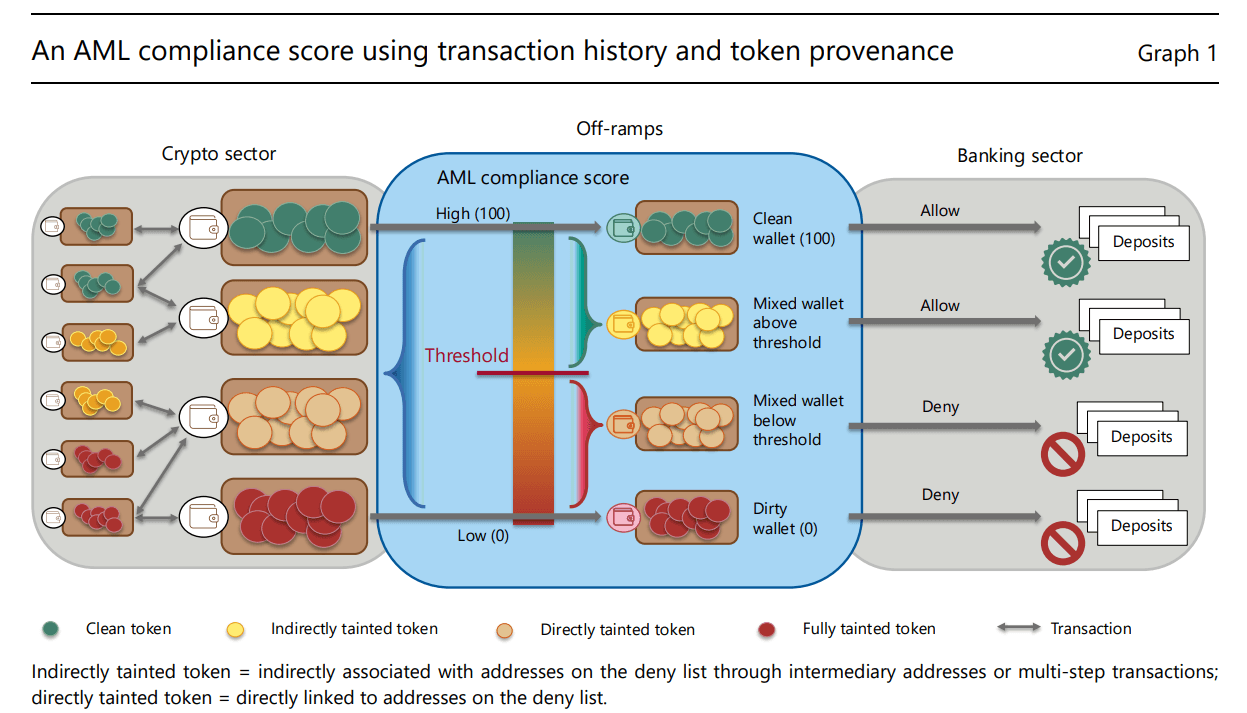
In accordance with the BIS, the complete transaction historical past out there on public ledgers may probably be used to find out whether or not tokens are “tainted” and block or penalize their conversion into fiat foreign money at off-ramps.
The central banks’ coordination physique wrote that “customers may fairly be anticipated to train an obligation of care in transacting with crypto tokens by checking beforehand if a crypto coin is thought to be compromised,” including that failure to conform may lead to fines.
“Whereas some customers might fairly declare to have acquired a tainted token in good religion if info on illicit use is scarce, such an argument can be much less persuasive if there have been widespread and reasonably priced compliance service suppliers,” BIS defined.
Threat of Fragmentation
The bulletin even acknowledged that such a system may fragment stablecoins, noting that these linked to illicit flows “may commerce at a better low cost relative to others with no such historical past.”
The proposal contains mechanisms starting from “enable lists” of wallets which have handed KYC checks to “deny lists” flagging addresses tied to prison exercise. The BIS claims the scoring could possibly be embedded into wallets or tokens themselves. Therefore, the system may even be prolonged to customers who transact solely via non-custodial wallets.
Ari Redbord, international head of coverage and authorities affairs at blockchain forensics agency TRM Labs, mentioned in commentary to The Defiant that whereas blockchain analytics can already determine publicity to illicit wallets, the secret is “making certain that any such rating doesn’t turn out to be a black field.”
He argued for what TRM calls “glassbox attribution,” the place compliance groups can see the pockets connections behind any rating and make their very own judgments.
Redbord added that embedding compliance rankings into tokens or requiring KYC for non-custodial wallets “may signify a major shift in how blockchain networks function” and will create “tiered property, the place the identical token is handled otherwise based mostly on its transaction historical past.”
He added that privateness can be in danger instantly, and that dangerous actors would probably swap to mixers or unregulated platforms.
“A scoring system may be one instrument within the toolbox, however it’s not an entire answer by itself. Regulators, standard-setters, and policymakers face a problem within the age of DeFi — how to make sure lawful customers can transact in a secure and personal method on public blockchains whereas conserving out dangerous actors who search to take advantage of transformative expertise,” Redbord mentioned.
The BIS famous the challenges however mentioned its plan may assist shut gaps within the international monetary system. With stablecoins now accounting for 63% of illicit crypto transactions in 2024, in line with Chainalysis and TRM Labs knowledge cited within the report, BIS mentioned embedding provenance into regulation “emerges as a promising avenue to shut regulatory gaps.”

